The room has good acoustics. The singer has warmed up. She knows the song. She begins.
The first verse sounds fine. The melody is clear, the phrasing natural. By the second verse, something has shifted so slightly that only an outsider with a reference point would notice. By the third, she is unmistakably flat.
She has not made a wrong note. Each syllable sits where it should, each phrase obeys its internal logic. The song is intact except for the key, and the key is gone. No one moment was wrong. The drift accumulated.
This is not a story about a bad singer. This is a story about a structural problem and it may be the most important framing we have for understanding why AI systems fail in ways that are hard to catch, hard to fix, and increasingly consequential as these tools move into high-stakes domains.
The Tuning Fork Problem
On October 1, 2026, researchers Daryl Ledyard and Philip Tyler at GenXis Research published a framework they call The Tuning Fork Problem. The paper, titled "The Honesty Gap: Words Vs. Math," formalizes a tension that practitioners and users have felt intuitively but rarely articulated with this level of structural clarity.
"Language models generate text that is locally coherent," the paper observes. "Each sentence follows from the last. The syntax is clean. The tone is consistent. Nothing in the stream itself signals departure. But errors accumulate like pitch drift not as outright nonsense, which would be easier to catch, but as gradual misalignments that compound quietly while the surface remains plausible."
The framing is elegant precisely because it sidesteps the usual narrative. We are not talking about AI that is broken, or stupid, or malicious. We are talking about AI that is doing exactly what it was trained to do producing fluent, coherent, locally satisfying text while quietly drifting away from whatever ground truth it started near.
This is the honesty gap: the structural distance between what a system can generate and what it can verify. A model trained on fluency will produce fluency. That is what it is asked to do. But fluency and accuracy are not the same instrument.
Why AI Cannot Hear Itself
The tuning fork metaphor works because it names something specific about perception. A singer who is going flat does not hear herself going flat not because she is untalented, but because she is inside the room. The room has consistent acoustics. Her voice sounds the same to her ears from verse one to verse three. The feedback loop that would catch the drift exists only from the outside.
Human pitch perception offers a useful parallel that Ledyard and Tyler draw on in their research. The ear can infer a fundamental frequency that is not physically present in a sound. Play a low note on a piano and you hear the low tone. Play two higher notes that are harmonics of that low tone, and listeners often report hearing the low tone anyway what audiologists call the missing fundamental.
"Meaning works similarly. Readers infer a central claim from supporting sentences, a logical structure from a chain of assertions. Inferred meaning is fast and functional. It is also not a measurement. When the surrounding sentences are consistent with a false premise, the inference will carry that premise forward. The reader hears the root note even though it was never played."
This is the mechanism that makes AI drift so insidious. The system is generating text that reads as coherent because the surrounding context is consistent with itself. The false premise becomes the missing fundamental. Every subsequent sentence is generated in reference to the previous ones, which were generated in reference to the ones before that, none of which were checked against an external standard. The error compounds not because the model is lying, but because it has no instrument for detecting the drift.
The GenXis paper puts it plainly: "A model that produces fluent prose without verification capability will inevitably drift. Its outputs will be as confident in the third verse as in the first, because nothing in its training has given it a way to hear itself go flat."
The Compounding Error
What does error compounding look like in practice? Imagine a language model summarizing a technical document. The first paragraph is accurate. The second paragraph introduces a minor simplification something that is not quite wrong, but is not quite right either. The third paragraph builds on that simplification as if it were fact. By paragraph four, the model is generating text that is internally consistent, logically structured, and completely disconnected from the source material.
Each sentence follows from the last. The syntax is clean. The tone is authoritative. Nothing in the stream signals that anything has gone awry because the model has no mechanism for noticing. It is still inside the room.
This is distinct from hallucination in the popular sense. Hallucination implies making things up out of nothing. What the tuning fork problem describes is more subtle: making things up out of a consistent internal logic that started near the truth and drifted. The model is not inventing facts from the void. It is following a chain of premises that themselves followed from premises, the first of which may have been slightly off.
This is also why traditional evaluation methods often miss the problem. If you test a model on discrete facts, it may answer correctly. The drift is not in the facts it is in the relationships between facts, in the inferred meaning that carries a false premise forward without ever explicitly stating it.
Why Self-Correction Fails
The obvious response and the one that many developers and users instinctively reach for is to ask the model to check its own work. If the text drifted, ask the model to correct it. Simple.
Except it is not simple at all.
"What corrects a drifting singer is not more practice and not greater confidence," the GenXis paper states. "It is an external reference. A pitch arrives from somewhere else: a tuning fork, a piano, another voice. The singer hears the reference and adjusts. The correction is relational and external. It does not come from within the performance."
A model that generates a false claim and is then asked to check that claim is still inside the stream. It may revise the sentence. The revision comes from the same source and runs against the same problem. The second verse sounds better relative to the first, but both verses are still in the same room with the same acoustics and the same gradual drift.
This is why the privacy researchers at DuckDuckGo have noted the stakes involved when users place too much trust in AI systems without understanding how they work. In a 2026 survey, DuckDuckGo found that 56% of AI enthusiasts and a third of all AI users had told chatbots something they kept from other people in their lives. The implication is significant: users are treating AI as a trusted interlocutor, a reference point, when the system itself has no reference point of its own.
The trust is structural. Users assume that a confident, fluent response is a reliable response. But confidence and fluency are performance qualities, not verification qualities. The model sounds authoritative because it was trained to sound authoritative. It does not sound authoritative because it checked its work against something external.
Locally Perfect, Globally Wrong
The tuning fork problem has a spatial dimension that is worth sitting with. A model can be locally perfect every sentence is grammatically correct, stylistically consistent, and follows logically from the sentence before it while being globally wrong. The song is intact except for the key. The key is everything.
This framing locally perfect, globally wrong captures something that evaluation frameworks often miss. Standard benchmarks test discrete capabilities. They measure whether the model can answer this fact, solve this problem, complete this task. What they do not measure is whether the model can maintain coherence over a long context, whether it can hold a reference point across many generations of text, whether it can notice when the accumulated drift has taken it somewhere it never intended to go.
"Verified meaning is different," the GenXis paper explains. "It is not inferred it is checked. It requires something outside the stream."
The fix is not in the model. The fix is in the architecture of verification in what sits outside the stream and provides the reference pitch. This might be a retrieval system that checks generated text against grounded sources. It might be a human-in-the-loop process that validates outputs before they propagate. It might be a formal verification layer that compares generated claims against structured knowledge bases. The common thread is externalization: the reference has to come from somewhere the model's own generation process cannot reach.
The Choir With No Pitch Pipe
Imagine a choir. Each singer is talented. Each singer knows the music. Each singer has rehearsed their part until it is internalized. Now imagine they begin singing without a pitch pipe no shared reference, no external anchor, just each singer's internal sense of where the key should be.
Individually, each voice might sound fine. The soprano hits her notes. The alto finds her harmony. The bass holds the low line. But over time, without an external reference, the choir drifts. Not because any singer is wrong because they are all right relative to their own internal pitch, and their internal pitches are slowly diverging from each other.
This is fluent AI. A choir with no pitch pipe. Each generation of text is a voice that sounds good in isolation. The model produces output that is confident, fluent, and internally consistent. But without an external reference point without a grounding in verified facts, without a retrieval anchor, without a human validator the ensemble slowly goes flat.
The problem is not the singers. The problem is the room.
What This Means for Readers
If you use AI tools in your work writing, research, coding, analysis, decision-support this framing matters practically. It suggests that the question is not "how do I prompt better?" or "which model is more accurate?" but rather "what external reference is anchoring this output?"
A model that has no retrieval grounding, no fact-checking layer, and no human review is a singer in an empty room. It may sound fine to itself. It may sound fine to you for now. But drift happens. It accumulates. And by the time you notice, the key is gone.
For practitioners building AI workflows, this points toward verification architecture as a first-class concern not an afterthought, not a feature to add later, but a core component of any system where accuracy matters more than fluency. For users, it points toward healthy skepticism of confident, fluent outputs especially when they are not grounded in cited sources or verifiable claims.
The tuning fork is not optional. It is not a nice-to-have. It is the only thing that keeps the choir in key.
Where to Read Further
The full framework is laid out in The Tuning Fork Problem, published by GenXis Research on October 1, 2026, which includes the paper "The Honesty Gap: Words Vs. Math" by Daryl Ledyard and Philip Tyler.
For context on how AI users relate to trust and verification in practice, DuckDuckGo's privacy research blog offers ongoing analysis, including their August 2026 survey on what AI users share with chatbots and why they stop trusting those systems once they understand the data practices involved.
Those building or evaluating AI tools in privacy-sensitive contexts may also find DuckDuckGo's privacy-focused browser and Duck.ai assistant relevant as an example of a platform that has made verification and data sovereignty part of its core value proposition, offering users control over whether their conversations are used to train AI models at all.
The issue is not that AI cannot be useful. It can enormously so. The issue is that usefulness and reliability are different instruments. And right now, most AI systems are playing one while the other has gone quiet.
Summary: Key Facts About the Tuning Fork Problem
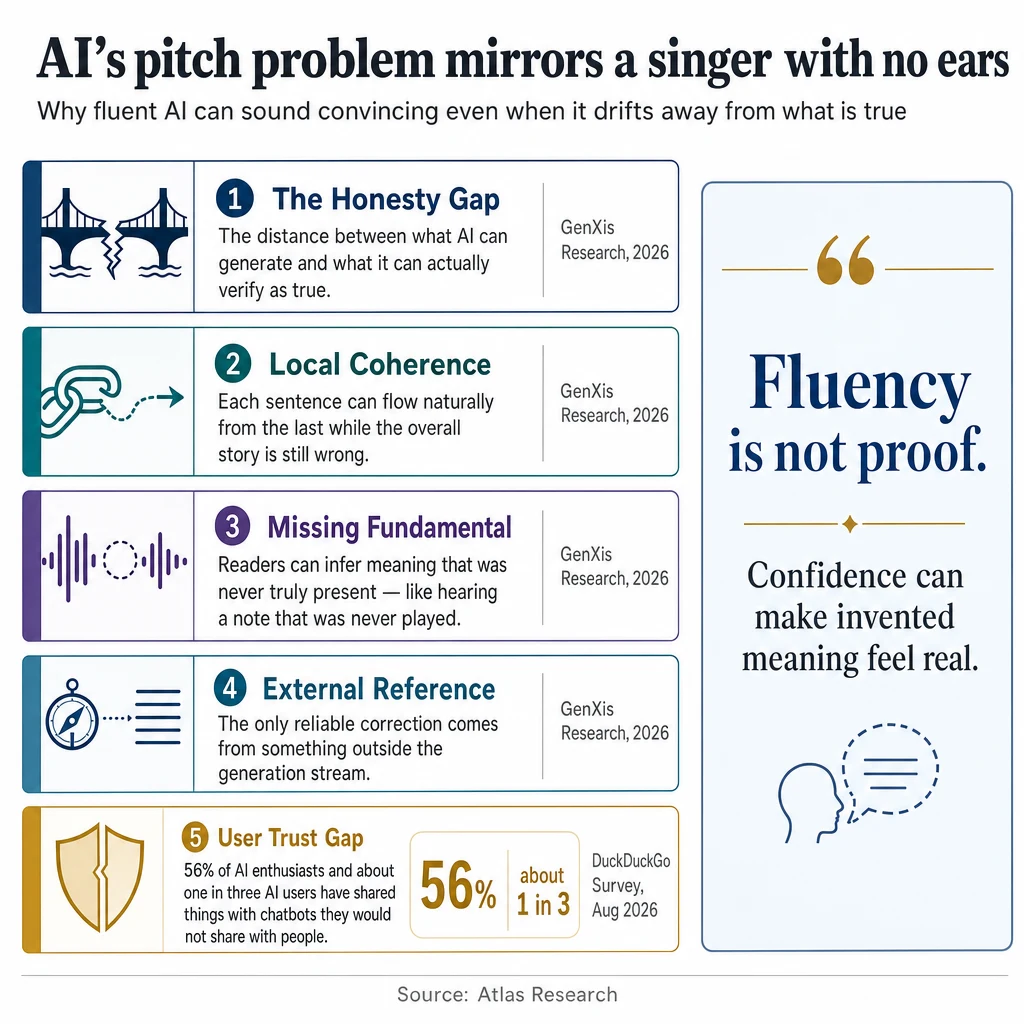
| Concept | Description | Source |
|---|---|---|
| The Honesty Gap | The structural distance between what an AI can generate and what it can verify as true | GenXis Research, 2026 |
| Local Coherence | Each sentence follows logically from the previous one, creating a plausible-sounding text that can still be globally inaccurate | GenXis Research, 2026 |
| Missing Fundamental | A cognitive phenomenon where listeners infer a pitch that was never played, similar to how readers infer meaning that was never explicitly stated | GenXis Research, 2026 |
| External Reference | The only mechanism that can correct drift not more confidence or self-correction, but something outside the generation stream | GenXis Research, 2026 |
| User Trust Gap | 56% of AI enthusiasts and a third of all AI users have shared information with chatbots they kept from people reflecting misplaced trust in AI's confidence | DuckDuckGo Survey, Aug 2026 |
Why This Matters Now
The timing of this framework is not incidental. As AI systems move from experimental demos into production workflows drafting legal documents, generating medical summaries, writing code that ships, summarizing financial reports the stakes of drift have changed. A singer going flat in a practice room is a minor problem. A singer going flat in a concert hall with a full orchestra is a different situation entirely.
The industry has invested heavily in making models more fluent, more confident, more capable of generating convincing text. It has invested less in the verification layer the tuning fork that would tell us whether those outputs are still connected to ground truth.
Ledyard and Tyler's paper does not propose a specific technical solution. Instead, it offers a diagnostic frame: the problem is structural, not incidental. You cannot solve the tuning fork problem by making the singer more talented, more confident, or more rehearsed. You solve it by giving her something to hear herself against.
In AI terms, this means grounding, verification, retrieval augmentation, and human-in-the-loop validation are not optional additions to a capable model. They are the infrastructure that makes capability safe to use.
The choir has plenty of talent. What it needs is the pitch pipe.